
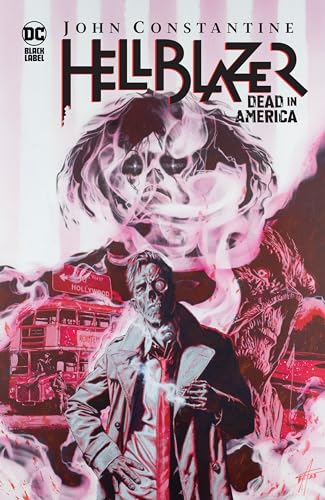
John Constantine, Hellblazer: Dead in America
Simon Spurrier, writer; Aaron Campbell, Lisandro Estherren, artists; Jordie Bellaire, colors
DC Black Label, 2025
As a longtime Vertigo fan, it was a treat to see John Constantine at the center of an epic story that ultimately involved a large cast of historic DC Universe occult characters. As the story opens, Constantine is far from his native England (the setting of most Hellblazer stories: he is English to the core, whatever else you might say about him). Constantine, his son Noah, and his “bodyguard” Nat are on the run in America and wanted for murder. They are traveling in a London double-decker bus, a great visual element that emphasizes his British identity while also showing how very out of place he is. Oh, and one other complication: John’s heart has stopped beating, and his body is quite literally decaying more and more with each passing day.
Dream of the Endless needs Constantine’s help. Something has turned the spirit of America towards dark places, and whoever is behind it is using sand from the Sandman’s pouch to do it. The pouch is the only one of his tools of power (the ruby, helm and pouch) that were taken from him when he was imprisoned by Roderick Burgess that has not been recovered. That event goes back to the very beginning of The Sandman, which gives an idea how wide-ranging this story witll be. One of John’s first stops is the retrieval of his old ally Swamp Thing (although “ally” may be a strong word: the two have a complicated relationship). Swampy is in bad shape due to the terrible decline of America’s ecosystem, which goes way beyond mere climate change.
Constantine even travels to Hell, a recuring motif in the series. This presents Spurrier with the opportunity to write Etrigan the rhyming demon, which he unfortunately accepts. Etrigan is a character I did not need to see again. He makes a bargain to save his son’s soul, which sets up an interesting twist later. In the end he uses this as a tool to defeat the Kindly Ones, who were also responsible for the misuse of Dream’s sand. Apparently both John and Dream get what they want.
The ending features a play on the old “how do you confuse a vegetable?” gag, with Death in the place of the Swamp Thing. John asks “how do you confuse an anxious reader?” Death says she doesn’t know, then turns to find Constantine gone, the bar empty and long-deserted. Bonus material includes a full-sized gallery of variant covers; an Afterward and series pitch by Si Spurrier; shooting reference photos by artist Aaron Campbell; and four pages of script, with the accompanying art.
This was a terrific showcase for Constantine, making use of a great deal of history. However, Spurrier was having so much fun that he sometimes went over the top on the flowery dialog. And the miniseries was overlong at eleven issues.


You must be logged in to post a comment.