
 Continuing our rough chronological trip through Vertigo miniseries, we come to American Freak: A Tale of the Un-Men, a five-parter by Dave Louapre and Vince Locke based on minor Swamp Thing characters. These Un-Men are only loosely connected to the originals created by Anton Arcane (which didn’t stop Vertigo from using this story as the background for the recent Un-Men series). Louapre’s “On The Ledge” column says that this was his first attempt at a traditional comics format, and it shows. It’s too wordy, and the story took forever to get going: it took three issues just to get to the real point. I remember liking Locke’s art in The Sandman, but it seems drab here, and it’s not helped by the muddy coloring. Reminds me a lot of Guy Davis, which would normally be a good thing. Interesting that they both live in Michigan. Must be something in the water! The story finally got moving at the end. The Un-Men achieve closure, and Damien Kane even finds some peace. I suppose the commentary on American celebrity culture was a big part of the intended point. Might have been effective if it hadn’t been so heavy handed, and if the story hadn’t gone all over the place before it got there. I have trouble even seeing the point of the series, other than hauling out some old DC baggage that isn’t creator-owned. Just goes to show that not everything Vertigo is golden, even in the early glory days that most fans look back on so fondly.
 The first “Vertigo Visions” one-shot was The Geek by Rachel Pollack & Michael Allred. The “Vertigo Visions” stories have all been based on obscure DC characters, in this case Brother Power the Geek. Neil Gaiman had revived the character for a Swamp Thing story, and Chester (the recurring hippie character) also shows up here. I’m sure the story was intended as an indictment of the greedy ’90s, but it’s so surreal that it’s hard to take it seriously as social commentary. Allred had a lot of fun with the art, which helps keep things interesting, albeit incoherent.
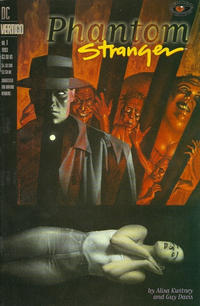 The second “Vertigo Visions” issue was Phantom Stranger by Alisa Kwitney & Guy Davis. This is more like it! It’s the story of Naomi Walker, a woman who comes to a retirement home to be the night caretaker. The house and its occupants become increasingly bizarre and frightening, until it’s revealed that this is an “infernal house” that is part of Hell. The Stranger helps Naomi to remember who she is, and her true role. The story ties into the larger Vertigo narrative by using Lucifer’s abdication as the setup for the chaos in the house. But it really does stand alone as a fine self-contained horror story. Worth seeking out if you haven’t read it.
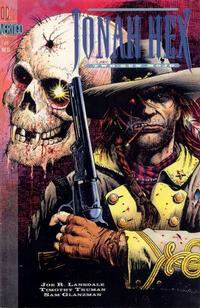 Still back in 1993, Vertigo published the first Jonah Hex miniseries, Jonah Hex: Two-Gun Mojo by Joe Lansdale, Timothy Truman, and Sam Glanzman. It’s considerably grittier than the current series, but it doesn’t go out of its way to earn the “Mature Readers” tag. Strong characterization in both writing and art, for the supporting characters as well as Hex. Vertigo really went all out for this one. The issues had 30 pages of story, no ads, and they were printed on heavy paper stock, with cover illustrations front and back. There’s even a letter column, starting with the first issue (that one includes a short Jonah Hex history, as well as a letter requesting the return of the character, from the “Inside DC” column that used to run in all DC titles). In the first two of the five parts the horror elements were only hinted at: it was mostly a Western. Then it took a supernatural turn as Hex is captured by the sideshow he has been pursuing for the murder of Slow Go Smith. Doc Williams had spent time in Haiti and New Orleans, learning voodoo and the art of zombification. Hex escapes before suffering the same fate, and resumes tracking the strange band. He finally catches up to them by accident while on the run from some Apaches, and joins them (plus the cavalry troop that was trying to protect them) in an epic battle. Hex and Doc both get away–with Apaches in pursuit–and Hex has his final revenge, leaving Doc alive so the Apaches can torture and kill him. So in the end the horror elements were fairly minor. It’s an excellent Western comic, successful enough to spawn two sequels, which I look forward to getting to as I work my way up to the present.
 John Smith & Scot Eaton’s Scarab is one of the odder early Vertigo titles. It’s a superhero/horror blend, a bit like the early issues of The Sandman: the Phantom Stranger makes a prominent appearance in the second issue. It was originally announced as an ongoing series, then cut back to an 8-issue miniseries as a trial. Apparently it didn’t do well enough to get any sequels. It really piles on the mystical elements, including a bunch of gibberish about ancient gods and fate. The Stranger says stuff like “The world-skin is diseased; the wheels of Chance are turning too fast.” There are some abstract sequences similar to ones in Swamp Thing when the artist was trying to portray transitions to the Green or the spirit world (Eaton had worked on Swamp Thing recently at the time). It’s actually better than I’m making it sound, enough so that I expect to finish it. But it’s kind of ugly visually, including muddy coloring, and also has the ugliest Glenn Fabry covers ever. Issues #3 – 4 are set in a fictional North Carolina coastal town called Whitehaven. All of the men have committed suicide, with mysterious Dionysian fertility rites that called the movie “The Wicker Man” to mind. The Scarab investigates (in and out of costume) and finds a dying fertility god behind it. Apparently there is some connection to his wife, which ties into the larger storyline of him seeking her spirit while her body lies in the mysterious labyrinth. This storyline could work in Hellblazer, if not for the silly superhero costume. The arc started in issue 6 involves psychically capturing the scream of the Hiroshima dead and using it as a weapon. Reminds me a bit of The Invisibles, but it’s even more arcane and incomprehensible. In the end I was glad to see the last of it. There was a letter column starting with the fourth issue–comics still had letter columns then–and I can’t believe the letters they ran comparing it to The Sandman. Doing that right requires a lot more than pretension and a bunch of nonsense about World Webs and Labyrinths. By the eighth and final issue I was rolling my eyes so much I was having trouble reading.


 Mr. Vertigo
You must be logged in to post a comment.