
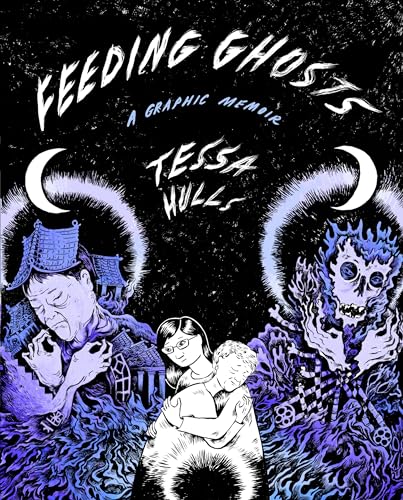
Feeding Ghosts: A Graphic Memoir
Tessa Hulls
MCD, 2024
Winner of the 2025 Pulitzer Prize for Memoir or Autobiography, Tessa Hulls tells the story of three generations of Chinese women: her grandmother, Sun Yi; her mother, Rose; and herself. Sun Yi was a Shanghai journalist caught up in the 1949 Communist victory in China. After eight years of government harassment, she fled to Hong Kong with her daughter. There she wrote a bestselling memoir about her persecution and survival, used the proceeds to place Rose in an elite boarding school, and then had a breakdown that left her committed to a mental institution. Rose eventually came to the United States on a scholarship and brought Sun Yi to live with her.
Tessa watched her mother care for Sun Yi, both of them struggling under the weight of Sun Yi’s unexamined trauma and mental illness. Hulls describes these unresolved tensions as the titular ghosts her family lived with. Rose was terrified that Tessa might have inherited the seeds of Sun Yi’s mental problems, and Tessa felt loved but smothered. As soon as she was old enough to leave the house she went away: the farther away, the better. But at the age of thirty she came home to face her family history, which ultimately resulted in this memoir.
The story opens with Tessa and Rose travelling in China, retracing Rose and Sun Yi’s escape route. The trip brought them together more than they had ever been, and it also involved reconnecting with family who had been left behind in China. Here as elsewhere, Hull provides enough background in Chinese history to put her family history in context. This is far from being a complete Chinese history, but there is a great deal, much of which is sure to be new to many readers.
The story is told in a kind of stream of consciousness: an event will trigger a childhood memory, which in turn will echo an event in Rose’s childhood, which might require some historical context. Hulls was also trying to come to terms with her mixed race heritage: depending on the setting, she often felt that she was “too Chinese” to blend in, or “not Chinese enough.” Creating the memoir was an intense process of coming to terms with these issues, combined with historical research. Hulls portrays her struggles vividly. Perhaps too vividly at times: I found reading it a consistently interesting experience, but not always a pleasurable one.


 Mr. Vertigo
You must be logged in to post a comment.