
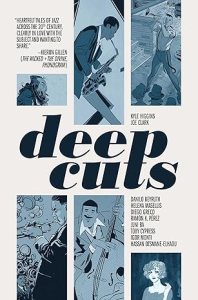
 Deep Cuts
Kyle Higgins & Joe Clark, writers; Danilo Beyruth, Helena Masellis, Diego Greco, Ramón K Pérez, Juni Ba, and Toby Cypress, artists; Igor Monti, colors; Hassan Otsmane-Elhaou, letters
Image Comics, 2024
This graphic novel presents the history of jazz via a series of vignettes. “What It Means” begins in New Orleans in 1917 when a clarinet player named Charlie meets his hero, Jack, a rogue trumpeter. There is no attempt to portray any specific historical figures (as far as I know, and I’m a jazz musician and critic), but the settings are accurate. Jazz is mainly performed in brothels and street parades. It’s basically a coming-of-age journey for Charlie, who is befriended by a hooker with a heart of gold and finally realizes that Jack has feet of clay.
“Sorry, But I Can’t Take You” picks up the story in 1928 Chicago. Now, jazz has become respectable enough that a Broadway musical composer named Gail Goldstein is encouraged to make the show’s hit song a jazz number. I suppose this is possible: one 1928 musical was “The Threepenny Opera,” which is known for its jazz influences (but the premier was in Germany). She returns home to Chicago, where she befriends a jazz musician. She writes “I’m Just Here for the Music,” which does not save the show. But for recordings she offers it to jazz players royalty-free, hoping it will make her name. It finally does, but that is a story for later. This installment featured lovely impressionistic art from Helena Masellis.
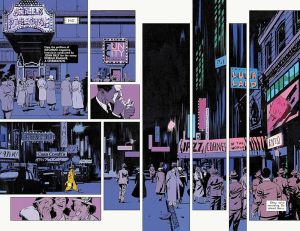
Bebop in NYC (click to enlarge)
In “K.C. Blues” (set in Kansas City, 1940), a young girl investigates the mystery of her father’s lost love of music. He meets up with Baron Redman, the musician associated with Gail’s tune. “Blue Notes” tells the story of a doomed bebop trumpeter in in 1956 New York City. The club scene is real, as are Dorian’s personal struggles. Historical accuracy would probably require a death by drug overdose (unfortunately), rather than a brain tumor. Striking art from Ramón K Pérez.
Finally, in “The Great Unknown” (Los Angeles, 1977), a jazz fusion band embarks on a world tour that may be their last. Keyboardist Alice goes on a research binge, and finds her way to “I’m Just Here for the Music,” as well as Leo Jones and Ace Stewart, closing the circle of the jazz history from earlier in the story. Toby Cypress provided effective cartoony art. I would be surprised to see any fusion band embrace traditional jazz this way–although all of the musicians would have studied it during their musical training–but it would be nice to see.

Connecting Covers (click to enlarge)
In the end the collection is an anthology based on jazz music as the theme, and like all anthologies it is a mixed bag. As a jazz lover I enjoyed it, warts and all.


 Mr. Vertigo
Glad you enjoyed it, Mark! I need to go back and reread it all together; I read them so far apart from each other that it wasn’t until chapter 4 or so that I realized threads from the early stories would extend into the later ones, the way music builds on the history of what has gone before.